Economic Survey Highlights Transformational Gains in Rural Drinking Water Supply
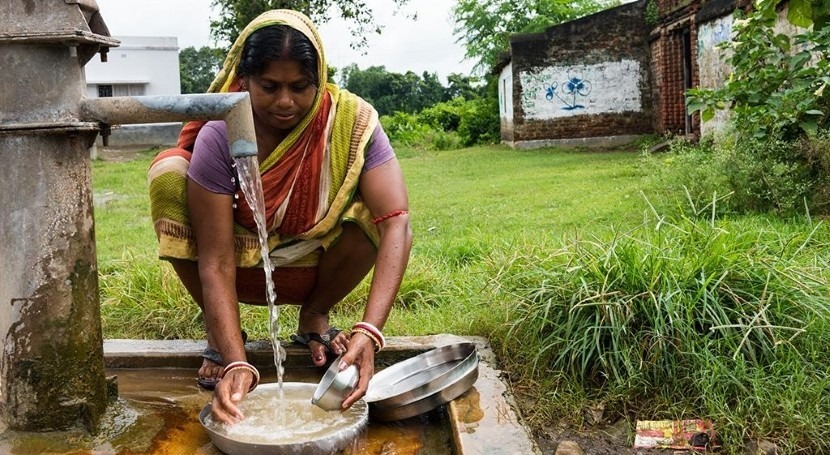
Lucknow | Uttar Pradesh has scripted a major success story in rural drinking water supply under the Jal Jeevan Mission, as revealed in the Uttar Pradesh Economic Survey 2025–26. The report presents a comprehensive picture of how the state has rapidly expanded access to safe and regular drinking water, moving beyond habitation-level coverage to reaching almost every rural household.
According to the Economic Survey, the Jal Jeevan Mission in Uttar Pradesh is progressing steadily toward its core objective of providing 55 litres of safe drinking water per person per day in rural areas. The scale and pace of implementation have positioned the state as a frontrunner in achieving the national vision of “Har Ghar Nal, Har Ghar Jal.”
Solar Power Driving Rural Water Projects
One of the biggest challenges in ensuring uninterrupted drinking water supply has been the availability of reliable electricity, particularly in remote and difficult terrains. To address this, the state has extensively adopted solar energy-based drinking water projects.
As of January 2026, out of 40,955 drinking water projects, 33,157 projects are being operated through solar power, with a total installed capacity of nearly 900 megawatts. These projects are expected to benefit 67,013 villages, ensuring drinking water access to approximately 13.30 crore rural residents.
The use of solar energy has not only accelerated project completion but has also significantly reduced operational costs while promoting environmental sustainability. The Economic Survey estimates that over a 30-year period, the state will save around ₹37,395 crore in operational expenses. Additionally, the shift to solar power is projected to reduce carbon dioxide emissions by nearly 13 lakh metric tonnes, marking a major environmental achievement.
91 Percent Households Covered with Tap Water
Under the Jal Jeevan Mission, Uttar Pradesh had set a target to saturate 2.67 crore rural households, covering a rural population of 16.69 crore, with tap water connections by December 2025. Against this target, the state has already provided 2.43 crore household tap connections, benefiting 15.12 crore rural residents, which accounts for nearly 91 percent of the total target.
At present, 46,303 revenue villages are receiving regular, adequate, and quality drinking water supply, reflecting the extensive reach of the mission across the state.

Youth and Women Powering the Mission
The Jal Jeevan Mission has also emerged as a major platform for skill development and community participation at the grassroots level. By January 2026, around 7.56 lakh youth have been trained as electricians, pump operators, plumbers, fitters, and motor mechanics, strengthening local capacity for operation and maintenance of water supply systems.
In a significant step toward women’s empowerment, 5.51 lakh women have been trained to test water quality using Field Test Kits (FTKs). These women are playing a crucial role in ensuring water safety and creating awareness about drinking water quality in their communities.
Focus on Cleanliness and Awareness
The State Drinking Water and Sanitation Mission has intensified public awareness efforts through initiatives such as the ‘Stop Diarrhoea Campaign’. Campaigns like “Know Your Water”, along with drives to identify and repair water leakages, have been implemented at district, block, and village levels to improve public health outcomes and ensure efficient water use.
A Model for Rural Transformation
The Economic Survey underscores that the Jal Jeevan Mission has gone beyond infrastructure creation to become a comprehensive rural transformation initiative—combining technology, renewable energy, skill development, women’s participation, and public awareness.
With rapid progress toward universal tap water coverage, Uttar Pradesh’s experience under the Jal Jeevan Mission is increasingly being seen as a model for large-scale, sustainable rural service delivery in India.